

You’ve been writing and publishing blog posts about your experiences as a business professional and how that experience has shaped your professional and personal lives. Guess what? Your book may already be written, or at least have a solid base from which we can start building an outline.
I had lunch with a colleague who said she has multiple blog posts written about her business experience. She doesn’t know what to do with them. Can you help?
That’s what my husband said when he got home from work. The answer was a resounding, “Yes! Of course, I can help your friend write her book or publish her blog!” Sounds like she needs a book coach, but if she’s done with writing, I can support her with interviews and write the book as her ghostwriter.
She already has years of blog posts and presentations that can serve as the basis for her book. It’s likely people are telling her, like I tell my husband, “Write the damn book!”
The Book Might Already Be Written
A book gives your ideas focus and purpose. It turns scattered posts into a single, focused story. When you turn content into book form, you give your audience a path to follow instead of asking them to piece you together from search results and social feeds. You can answer their most asked questions, and questions they never thought to ask but would love the answers, all in your book.
When you stand on stage, you can refer people to your book about your experiences. You can add it to your personal website and promote it on social media. And you own all of it, whether you use a ghostwriter, book coach, or write and publish it yourself.
In this guide, I walk you through how to shape the content you already have into a marketable book, how to set a realistic writing schedule, and when to bring in a book coach or book ghostwriter so you do not stall halfway through.
Key Takeaways: Turning Existing Content into a Book
- You can turn existing blog posts, talks, slides, emails, podcasts, and internal playbooks into a nonfiction book by organizing them into a clear reader path.
- Start with a content audit, list everything in one document, tag each item by topic and audience, then highlight what still feels current.
- Build your book concept around three points: reader (who it is for), the promise (what changes), and the path (the steps from start to finish).
- Repurposed content still needs a writing schedule. Plan 3 to 5 sessions per week, 30 to 60 minutes each, with one clear task per session.
- Choose support based on your time and goals: a book coach for structure and accountability, an editor for polish, a book ghostwriter to draft from your content and interviews, or From Posts to Pages if you want a guided path built specifically for repurposing what you already have.
Start with Content You Already Have
Most thought leaders underestimate how much content they already control.
Think beyond your blog and LinkedIn posts:
- Keynote or breakout session slides
- Webinars and training decks
- Email sequences and lead magnets
- Podcast episodes or guest interviews
- Internal playbooks and frameworks
Professional content authors are trained to spot patterns, themes, and gaps inside this kind of material. If you want a deeper view of that role, look at your own body of work through that same lens.
A simple first step is a content audit:
- List links to everything in a single document.
- Tag each piece with a topic, audience, and format.
- Highlight the pieces that still feel current and strong.
Don’t rush the process. As you go along, you may see patterns or clusters of topics. Make notes of what you see and continue auditing. Shh, don’t tell anyone, but you’ve already started to compile ideas for your book!
Shape a Clear Book Concept from Your Content
Once you see your content in one place, patterns appear. Maybe you teach the same framework in every talk, or you return to three core stories over and over. That is the spine of your book.
Clarify three things before you write new material:
- Reader: Who is this book for, in one short line?
- Promise: What will change for them by the last page?
- Path: What are the main stepping stones that carry them from point A to point B?
Group your existing content under those stepping stones. Blog posts and talks become early drafts of chapters. Gaps in the path show you where you need new material.
At this stage, your goal is not pretty sentences. It is a workable structure. Think of it like laying out puzzle pieces on the table before you start locking them together.
This step lines up with the Outlining stage of the STORIES Framework, the same seven-stage process I use for every project, whether it is one blog post or a full manuscript. Once you can name your reader, your promise, and your path, you are already outlining. It just does not feel like outlining yet.
If you feel stuck, that is a normal part of this stage. It is worth a conversation about how a book coach can support and move your project ahead.
Create a Writing Schedule to Finish the Manuscript
Repurposed content still needs focused time. A book is not just a folder of old posts, it is a single, guided reading experience. That means you need a steady writing schedule instead of “when I feel like it.”
For busy speakers and business owners, a flexible schedule works better than a rigid one:
- Choose 3 to 5 sessions per week.
- Aim for 30 to 60 minutes per session.
- Assign each session a clear task (rewrite chapter 2 intro, expand story, tidy transitions).
Many authors find success after time away by starting with shorter sessions and building up. That “small but steady” approach is key when you are balancing travel, client work, and life.
As you revise older posts into chapters, keep an eye on search visibility too. The same skills that power your blog will help your book marketing.
If you think you’re too busy to write, a realistic writing schedule built around your actual week, not a fantasy one, changes that.
Choose Your Support Team: Book Coach, Editor, Book Ghostwriter, or From Posts to Pages
You do not need to write a book alone. In fact, most busy leaders should not.
Here is a simple way to think about the support you might need:
- Book coach: Helps you shape the idea, plan the structure, set your writing schedule, and stay accountable. A nonfiction book coach is ideal for experts turning lived experience and systems into a clear promise for readers.
- Editor: Comes in once you have a rough or full draft. Focuses on clarity, flow, and language.
- Book ghostwriter: Writes the draft for you, using your notes, content, and interviews. You provide the ideas, stories, and tone, and the ghostwriter builds the manuscript.
- From Posts to Pages: A guided program built for exactly this situation, turning content you already have into a finished manuscript. It is a more structured, more affordable path than full ghostwriting, with support at each stage of the process instead of starting from a blank page.
For thought leaders with heavy travel or client loads, a book ghostwriter can speed up the process without losing your voice.
If you prefer a more hands-on role, a book coach can walk beside you rather than write for you. I offer book coaching packages that combine structure, weekly guidance, and realistic planning for busy professionals.
The key is to match support to your time, energy, and goals, not to force yourself into a DIY plan that will never fit your life.
Step-by-Step Path to Turn Content into a Book
At this point, you know what you want to say and how you will get the work done. Here is a simple path you can follow, with a few targeted writing tips along the way.
- Draft a working title and subtitle. Make the outcome clear for one reader group. You can refine this later, but a sharp working title keeps you focused.
- Turn your themes into a table of contents. Each chapter should answer one big question or solve one clear problem.
- Match content to chapters. Drop links or text into a document for each chapter. Old posts become raw material, not final copy.
- Fill the gaps. Where you have no content yet, jot quick bullets and stories you tell in talks or podcasts. Those are often your strongest sections.
- Revise for book flow, not blog flow. Remove repeated ideas. Add transitions that guide the reader forward. Your goal is a clear journey, not a series of stand-alone pieces.
- Add stories and examples. Even data-heavy books need human moments. Imagine one client or audience member as you write, and talk to them.
You do not need a complex system. You need a path you will actually follow. Treat your book like another high-value project. Protect the time, get the right support, and accept that “good and finished” will help more people than “perfect and still in your head.”
Ready to Turn Your Content into a Book?
You already did the hard part: years of thinking, refining, and sharing your ideas in public. Turning that into a book is the natural next step, not a whole new career.
If you want a partner for the process, from idea to finished manuscript, consider working with a nonfiction book coach who understands thought leadership, speaking, and content marketing. As a Charlotte, NC-based writer and book coach, I help speakers, consultants, and founders turn their existing content into books that support their businesses and brands.
If you already have content sitting in blog posts, talks, or old drafts, From Posts to Pages is built for exactly this moment. It is a guided path from what you already have to a finished manuscript, with more structure than going it alone and a lighter investment than full ghostwriting.
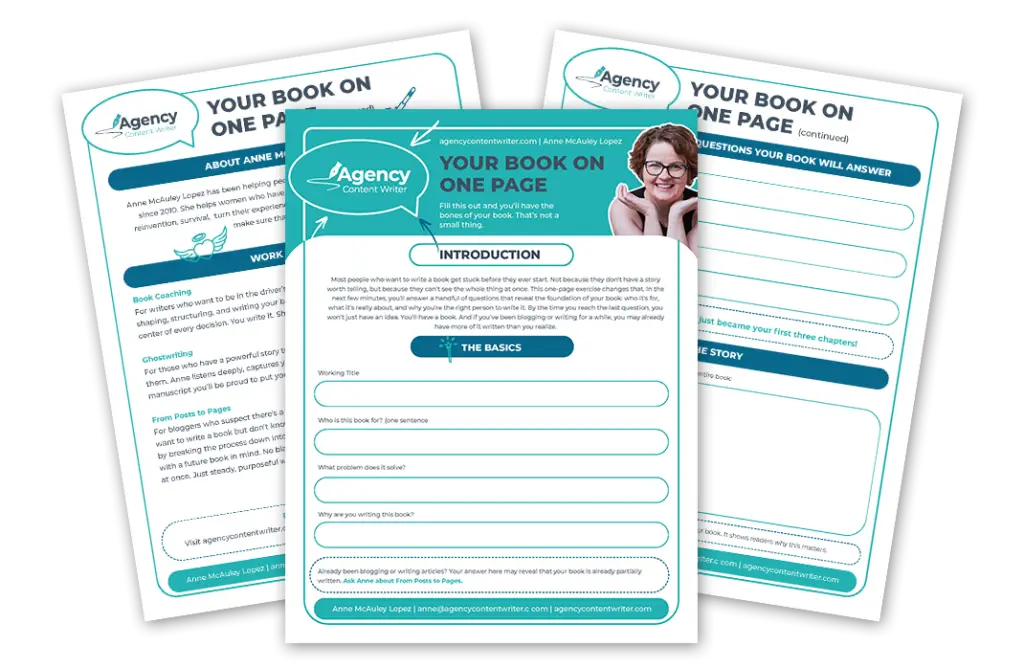
If you are ready to move from “someday” to “in progress,” start with Your Book on One Page. Fill in four sections and you will have the bones of your book, no blank page required. Your book is closer than it feels. You might have existing content that we can turn into a book with a bit of focus and clarity. I look forward to chatting with you!
Related Links
- Book Ghostwriting Services
- How to Write a Book: A Deep Dive into the STORIES Framework
- How I Used Claude + STORIES Framework to Build the Writing Plan for My Book
- Book Ghostwriting for Speakers and Thought Leaders
Frequently Asked Questions About Turning Existing Content into a Book
What kind of existing content can I use to write a book?
Use more than blog posts. Your slides, webinars, email sequences, lead magnets, podcast episodes, guest interviews, internal playbooks, and frameworks can all become book material.
How do I organize blog posts into a book outline?
Start by clarifying the reader, promise, and path. Then group each post under the stepping stone it fits, treat each cluster as a draft chapter, and note gaps where you need new material.
What is a simple content audit process for building a book?
Put links, or files, into one document, tag each piece by topic, audience, and format, then highlight what is still strong and relevant. As you sort, you will see patterns that can become chapters.
Why does repurposed content still need editing for a book?
A book needs one guided reading experience. That means you remove repeats, add transitions, and revise sections so they flow as chapters, not stand-alone posts.
Should I hire a book coach, an editor, or a book ghostwriter?
Hire a book coach if you want structure, accountability, and help shaping the concept, and hire an editor after you have a rough or full draft. If you need someone to draft the manuscript, hire a book ghostwriter. If you want a guided path built specifically for turning existing content into a book, From Posts to Pages combines structure with a lighter investment than full ghostwriting.
Anne McAuley Lopez is a content writer and nonfiction book coach based in Charlotte, North Carolina. She specializes in book coaching and ghostwriting services for entrepreneurs, thought leaders, and nonprofit leaders ready to write their stories.