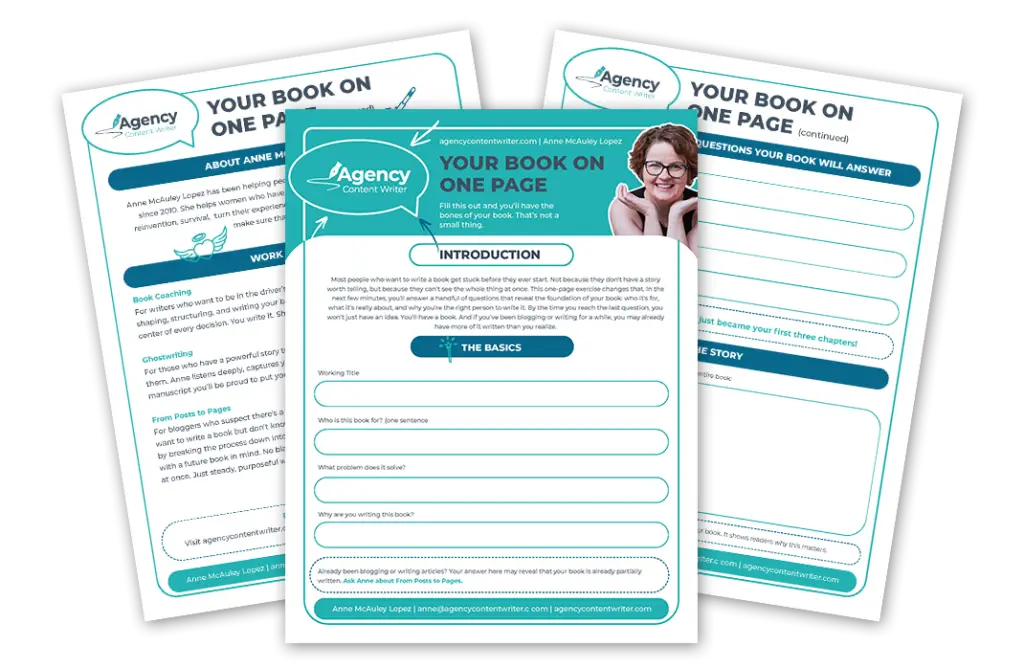


Everyone has a story. Yours just needs to be told. Whether you have 95 years of stories, 95 days, or 95 ideas scattered across notebooks and voice memos, the material was never the problem. Nobody ever showed you the process for turning it into something someone else could actually read. If you’re looking for how to write a book, check out the STORIES Framework.
It’s a proprietary methodology I built at Agency Content Writer, a book writing process for writers and nonwriters alike. It’s built for entrepreneurs, thought leaders, and women ready to stop carrying their story alone. Spark, Tidying, Outlining, Running with It, Immersing, Evaluating, and Sharing aren’t abstract stages I invented to sound organized. They’re the real shape every book has taken, mine included. This is the deep dive on how to write a book using each stage, with real examples from my own memoir and from client projects I’ve guided through the process.
Key Takeaways
- The STORIES Framework is the proprietary process by Agency Content Writer. It’s a seven-stage process. A 95-year-old client’s memoir and my own book about a quiet midlife identity crisis moved through the same seven stages, just with different material.
- Having more material than you need is a gift, not a problem. The real work of Tidying and Outlining is choosing the strongest stories, not generating more of them.
- The clearest insights rarely show up on the first pass. A conclusion that wraps back to the beginning, or a theme that needed to run through every chapter, usually reveals itself while you’re deep in the work, not while you’re planning it.
Spark: The Moment That Wouldn’t Let Go
Every book starts with a spark, the original moment or feeling that simply won’t let go. For my own second book, a memoir called Charlotte and the Existential Crisis, the spark was a dinner conversation with my husband, Eddie, when I said out loud, “I think I am burnt out from writing for others. I don’t feel the spark as I did years ago.” That one sentence became the seed for the whole manuscript.
A spark doesn’t have to be a polished scene or a chapter idea. It’s the moment that keeps pulling you back. Once I had that sentence, I needed a way to sort through what came next without losing the thread, which is where Claude and the STORIES Framework worked together as a thinking partner, turning scattered notes into an actual writing plan instead of a pile of good intentions.
Tidying: Turning Scattered Material Into Something With Shape
Tidying is where you gather everything that already exists and start sorting it before you organize anything into chapters. For my own book, that meant journal entries, voice notes, and half-formed scenes. For a client of mine, a 95-year-old woman writing her memoir to benefit her nonprofit, it meant something much bigger: 95 years of notes, journals, and Toastmaster speeches.
We started with content she had already generated through StoryWorth prompts over the course of a year, alongside her Toastmaster speeches, and began organizing it into something usable. The challenge wasn’t finding material. It was making sure a book built from 95 years of life didn’t turn into a 1,000-page manuscript nobody could finish reading.
That’s the real work of Tidying. Having a lot of material is a gift, not a burden, but only once you start sorting it into something with shape.
Outlining: Finding the Themes That Hold the Book Together
Outlining is where tidied material turns into an actual chapter structure. For my 95-year-old client, that meant stepping back from the raw material and asking what the real themes were. We landed on a few: her early life challenges, her experiences post-retirement, and travel, which had shaped so much of her later years.
Those themes became the sections we built the book around. That decision also meant we didn’t have to use every single story she had. With that much material to draw from, between the written content and interviews, we could choose the strongest stories in each section instead of stretching to include everything.
Running with It: Where Interviews Become Chapters
Running with It is the drafting stage, where organized material finally becomes chapters instead of an outline. This is where the real volume of work shows up. For memoir clients, each interview session typically becomes a chapter of the book, one conversation, one chapter, one piece of the whole. That was true for my 95-year-old client too, and it meant drafting moved in a steady rhythm: interview, transcript, draft, next interview.
That rhythm doesn’t mean every chapter arrives complete on the first try. We went back for a few additional sessions specifically to clarify details and fill gaps as we were drafting, rather than waiting until the whole manuscript was done to discover what was missing. A date that didn’t line up, a story that needed one more layer of detail, a name that needed confirming, all of it got resolved in the moment instead of piling up as open questions at the end.
Business books move through this stage a little differently. Instead of interview sessions mapping directly to chapters, drafting usually pulls from a mix of interviews, existing content, and research, woven together around the structure built during Outlining. The shape of the work changes depending on the project, but the underlying motion stays the same: organized material becomes real chapters, written in the author’s voice, not mine.
Once the full pass is completed on my clients’ memoirs, I go back through for a deeper edit to make sure the book flows as a whole, not just chapter by chapter. That deeper edit is where Running with It hands off to the next stage.
Immersing: Living Inside the Manuscript Long Enough to See What’s Missing
That deeper edit is Immersing. This is the stage where I step back from individual chapters and read the manuscript at a macro level, the way a reader eventually will, and look for what needs to change. Sometimes that means moving large portions of text between chapters. Other times it means writing new material for a section that feels thin next to the others. Occasionally, it means noticing a theme that deserves to run through the whole book, not just one chapter.
A current client’s project is a good example of that last one. During interviews, a theme kept surfacing. Now, as I work through the immersing stage on that manuscript, I’m making sure that theme is intentionally carried through the whole book rather than left as a handful of disconnected moments.
The same project also showed me something else about this stage: real clarity about how a book should end, and how it can wrap back around to something raised in the very beginning, doesn’t usually show up during outlining or even during the first draft. It tends to arrive later, often during the final interview, once you’ve walked through the whole process with someone.
Evaluating: The Honest Read-Through
Evaluating is where I read the manuscript both at the macro level and the micro level. Macro means checking that the story flows and makes sense the way a reader, not the author, would experience it. Micro means proofreading, checking details, and making sure the changes surfaced during Immersing actually landed the way they were intended.
Memoir adds another layer here. Stories often involve real people, children, relatives, former colleagues, and some of that material can be sensitive or even legally risky. Part of evaluating a memoir honestly means considering those moments carefully before the manuscript moves forward, not catching them after the fact.
Evaluating also includes an author review. Before the manuscript moves any further, the author reads through to confirm every story is clear, every detail is clarified, and, frankly, that we’re not including anything that could upset someone or land us in legal trouble.
Sharing: The Handoff, and Everything After It
Once the macro and micro evaluation is done, my part of the drafting process ends and the manuscript goes to the author for review. I build in questions along the way, details about specific years or ages, or whether to include a particular story or side of an experience in the final draft, so the author can walk through the manuscript and answer them directly.
Once that’s done, I do a final format, and from there it goes to a trusted collaborator who handles the final edit and prepares it for publishing.
Sharing doesn’t stop at that handoff, though. Self-published authors become their own marketing department, whether that’s working alongside a collaborator’s marketing team or pushing out information about the book themselves. Sharing also includes the earlier version of this, getting the manuscript in front of beta readers before publication, not just promoting it after the book is out in the world.
Conclusion
Seven stages, one process for how to write a book. Spark is the moment that won’t let go. Tidying turns scattered material into something usable. Outlining finds the themes that hold a book together. Running with It turns organized material into real chapters. Immersing means living inside the manuscript long enough to see what still needs to change. Evaluating is the honest read-through, close up and from a distance. Sharing is the handoff, and everything that comes after it.
It works whether the book is a 95-year-old’s life story or your own quiet midlife reckoning. The material you need is usually already there. What most people are missing isn’t more stories. It’s a process for turning the ones they already have into something a reader can follow start to finish.
Wherever you are in that process right now, even if you can’t name the stage yet, that’s a normal place to be. Schedule a consultation and let’s figure out together which stage you’re actually in.
Related Links
What I’ve Learned From Both Sides of the Memoir Ghostwriting Process
Should I Write A Book Using AI?
That Book You’ve Been Meaning to Write
Frequently Asked Questions
What’s the best way to learn how to write a book?
The most reliable way to learn how to write a book is to follow a repeatable process instead of waiting for inspiration to strike. The STORIES Framework is the process I use to teach people how to write books, whether they’re working with a ghostwriter or drafting every word themselves.
What is the STORIES Framework?
The STORIES Framework is a seven-stage process for moving a book from idea to finished manuscript: Spark, Tidying, Outlining, Running with It, Immersing, Evaluating, and Sharing. Each stage builds on the one before it, and it applies to memoir and nonfiction business books alike.
What happens during the Tidying stage of writing a book?
Tidying means gathering everything that already exists- journals, notes, speeches, voice memos, interviews- and sorting it before organizing anything into chapters. The goal isn’t to generate more material. It’s to see what you already have clearly enough to start shaping it.
How do I know when a memoir manuscript is actually finished?
A manuscript is ready to move forward once it has gone through both a macro-level evaluation, checking that the story flows the way a reader would experience it, and a micro-level proofread for details and accuracy. For memoir specifically, it also means confirming that any sensitive material about real people has been carefully considered before the author’s final review.
What does “Sharing” mean in the STORIES Framework?
Sharing starts with handing the draft to the author for review. It ends with a finished, formatted book heading toward publication. It can also include getting the manuscript in front of beta readers before publication and the ongoing work of marketing the book once it’s out. As a self-published author, you are your own marketing department.
Can I use the STORIES Framework if I’m writing my own book instead of hiring a ghostwriter?
Yes. The framework describes the process a book goes through, regardless of who does the writing. A book coach can guide you through all seven stages. Then you will draft the manuscript yourself, rather than having a ghostwriter write it for you.