
During my weekly catch-up call with my editor/project manager, the topic of AI came up. We’ve had clients who want to use AI to write their entire book, which we do not recommend. I will explain why in this article. There are other clients who never ask about AI and still others who are AI-curious. The simple answer is that we have ethical ways writers like us can use AI; it’s a tool. Like any tool, it can be used well or poorly. The difference is in how you use it and what you use it for.
I’ve been a professional writer since 2010. I’ve watched blogging evolve, SEO shift, and social media platforms rise and fall. Nothing has disrupted content creation the way AI has. The conversation around AI ranges from fear (will it replace writers?) to overconfidence (AI can write my entire book!). Neither extreme is accurate.
The question is then, how do you use AI ethically while maintaining your voice, your stories, and your credibility as a writer? That’s what this guide addresses. You’ll learn which AI tools protect your privacy, which tasks AI handles well, and where human expertise remains irreplaceable.
Key Takeaways
- Choose AI tools that protect your privacy. Claude, by Anthropic, operates as a closed system where your conversations aren’t used to train future models, keeping your client stories and intellectual property confidential.
- Use AI for brainstorming, organization, and prompts. AI excels at generating topic ideas, organizing existing content into logical structures, and providing targeted writing prompts when you’re stuck.
- Never let AI write your entire book. AI doesn’t know your stories, your clients, or your unique experiences. Those human elements are what make your content valuable and authentic.
- Always edit and fact-check AI output. AI writes like an inexperienced writer and sometimes invents information. Every AI-generated sentence needs human review before publishing.
Why I Use Claude (And You Should Consider It Too)
When I decided to incorporate AI into my content creation process, I chose Claude specifically. Here’s why that matters.
Claude operates as a closed system. Your conversations aren’t used to train future models. Your client stories, your book ideas, and your proprietary content stay private. When you’re working with sensitive information or developing intellectual property, privacy matters.
ChatGPT and other open systems may use your input to improve their models. That means your unique ideas could theoretically show up in someone else’s AI-generated content. For writers working on books, client projects, or original content, that’s a risk worth avoiding.
The ethical choice is a tool that respects your work’s confidentiality.
Ethical Ways to Use AI in Your Writing Process
Idea Generation and Topic Exploration
AI excels at brainstorming. When you’re stuck on writing prompts for your book or need fresh angles on a topic, AI can generate possibilities you haven’t considered.
I use it this way: I’ll describe my topic and ask for 10 different angles or approaches. The AI gives me options. Some are terrible. Some are obvious. One or two make me think differently about the subject.
That’s useful.
You’re not copying what AI generates. You’re using it to spark your own thinking. That’s the ethical application.
Content Organization and Structure
AI can help organize your existing ideas into logical structures. When you have notes scattered across documents, presentations, and blog posts, AI can suggest how to arrange that content.
This is where AI shines for book projects. You likely already have your book content across your website, blog posts, and client testimonials. AI can help you see patterns and suggest organizational frameworks.
I’ll paste my rough outline and ask: “What’s missing? What order makes the most sense? Where are the gaps?”
The AI doesn’t write my content. It helps me see what I already have more clearly.
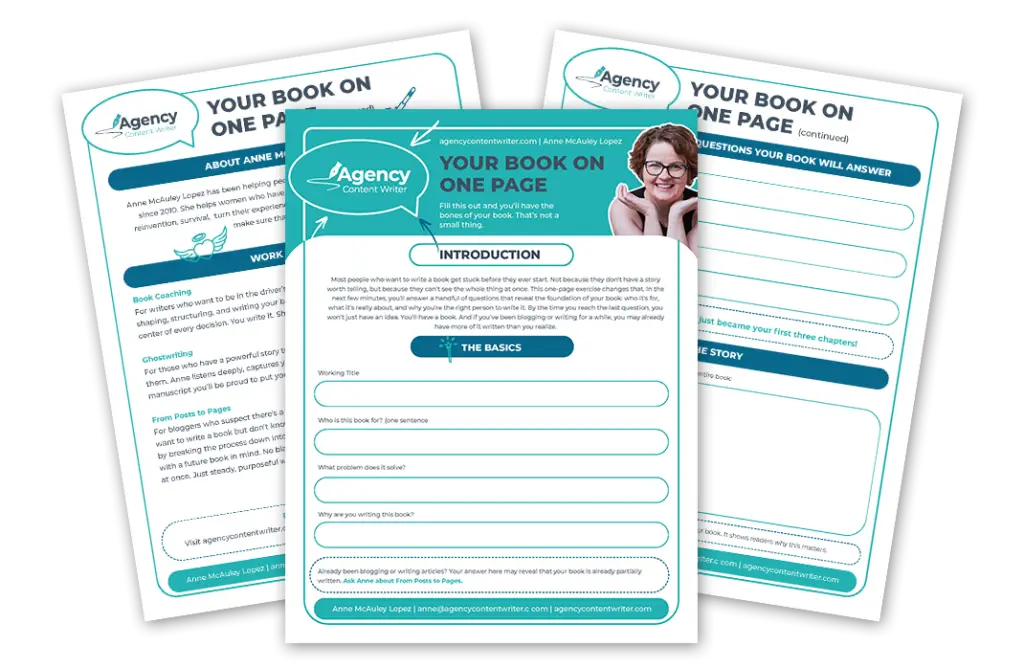
If you’re working with a book coach, this preparation makes your coaching sessions more productive.
Writing Prompts When You’re Stuck
Writer’s block is real. AI can help you get unstuck with targeted prompts based on your topic.
Different from generic writing prompts, you can ask AI for prompts tailored to your specific chapter, audience, or challenge. “I’m writing about nonprofit fundraising for small organizations. Give me five prompts that would help me explain donor retention strategies.”
You get targeted prompts. You write the actual content.
The ethical line is clear: AI suggests the question. You provide the answer from your expertise.
What AI Cannot (And Should Not) Do
I’ll say this louder for you: Do not use AI to write your entire book.
AI doesn’t know your stories. It doesn’t know that you ate peanut butter sandwiches in your car on your first business trip because the budget was nonexistent. It doesn’t know your client’s name, or the moment you realized your nonprofit could change lives.
Those stories are what make your book worth reading.
When writers ask if they should hire a ghostwriter or use AI, I’m direct: ghostwriters bring professional writing skills while preserving your voice and stories. AI generates generic content that sounds like everyone else.
Your book needs human expertise, judgment, and storytelling.
Additional Ethical Guidelines for AI Use
Be transparent. If you use AI in your process, don’t hide it. Bloggers who use AI ethically disclose their process and always edit AI-generated suggestions.
Always edit. AI writes like an inexperienced writer. Every AI-generated sentence needs human review, fact-checking, and refinement.
Fact-check everything. AI makes up information confidently. Verify any statistics, quotes, or factual claims before publishing.
Maintain your voice. If AI content doesn’t sound like you, rewrite it. Your readers recognize your voice. Sudden shifts to generic AI writing damage your credibility.
Give credit appropriately. AI can summarize articles or research. Always cite the original sources, not just the AI summary.
The Bigger Picture: AI as Assistant, Not Author
The ethical use of AI comes down to one principle: AI assists your work, not replaces your expertise.
Think of AI as a research assistant who can gather information, suggest structures, and generate options. You’re still the expert who evaluates, selects, refines, and adds the human elements that make content valuable.
When you’re deciding whether to hire a book coach, remember this: AI can’t provide accountability, strategic guidance, or help you work through the emotional challenges of writing a book. Humans do that.
Getting Started with Ethical AI Use
Start small. Pick one area where you struggle most. Idea generation? Organization? Getting unstuck when you’re blocked?
Use AI for that specific challenge. Evaluate the results. Keep what helps. Discard what doesn’t.
Give yourself grace as you figure out what works for your process and what feels authentic to your voice.
The goal isn’t to use AI for everything. The goal is to use it strategically for the tasks it handles well while you focus on the human elements that AI can’t replicate.
Your stories, your expertise, and your unique perspective are irreplaceable. AI is just another tool to help you share them more effectively.
FAQ
Will my readers know if I use AI in my writing process?
Not if you use it ethically and edit properly. AI should support brainstorming and organization while you write the content. Your voice, stories, and expertise come through when you’re the one writing. If you copy and paste AI-generated text without editing, readers will notice the generic tone and lack of authentic detail.
Is it dishonest to use AI without telling my clients?
Transparency builds trust. I tell clients how I use AI when they ask. Most appreciate knowing that I use it to improve research efficiency and organization while maintaining my writing quality and their confidentiality. The key is that AI assists your process rather than replacing your expertise.
What’s the difference between using AI ethically and just having AI write everything?
The difference is who does the actual writing and thinking. Ethical AI use means you ask AI for ideas; you evaluate which ones are useful, you organize your own thoughts with AI’s help, and you write the content yourself. Unethical use is copying AI-generated paragraphs directly into your book or blog without adding your expertise, stories, and voice.
Can I use AI to help write my book without it sounding generic?
Yes, when used correctly. Use AI to organize your existing content, generate writing prompts when you’re stuck, or brainstorm chapter structures. Then you write the actual chapters using your stories, client examples, and professional insights. The content stays authentic because you’re the author, not the AI.
Should I tell people I’m using Claude instead of ChatGPT?
If privacy matters to you or your clients, yes. Claude’s closed system means your conversations stay private and aren’t used to train future models. When you’re working with client information, book ideas, or proprietary content, choosing a privacy-focused AI tool is part of using AI ethically.
Ready to write your book with the right balance of tools and human expertise? Whether you need guidance on using AI ethically in your writing process or you’re looking for a book coach to help you finish what you’ve started, schedule a consultation to discuss your project.